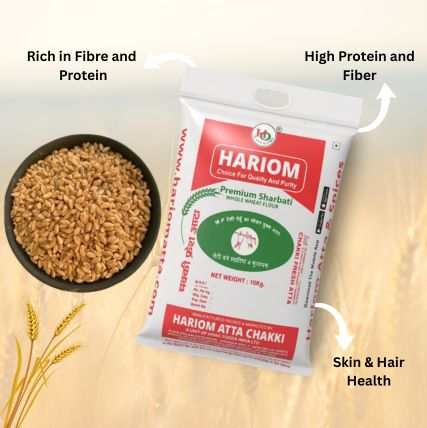
Ask anyone what sits in the bigger sack in their kitchen storeroom—not the premium 1kg pouch on the shelf, but the actual 25kg or 30kg bag that runs the household—and there's a massive chance the answer is Lokwan. It is the one wheat variety that does not get the glossy packaging treatment, yet it's the grain quietly making rotis in more Indian kitchens than almost any other.
Long before "premium atta" became a marketing category with its own shelf space, families were buying wheat by the sack based on one thing only—how much dough it gave per kilo and how the rotis held up through the week. That is the exact philosophy behind how we think about Lokwan wheat at Hariom—an honest, everyday grain that doesn't need a fancy story to earn its place in the kitchen.
Below is a straight breakdown of what Lokwan wheat actually is, how it compares to premium varieties like Sharbati, what it costs, and why this "regular" wheat deserves a proper look before you write it off as just the budget option.
First, What Is Lokwan Wheat Actually?
We need to clear this up before going further, because what is lokwan wheat is a question that comes up constantly from people who've only ever seen it listed as an option at the local kirana store without much explanation.
Lokwan wheat is a high-yield, hard-grain wheat variety grown extensively across Madhya Pradesh, Maharashtra, and parts of central India. It's one of the most commonly cultivated commercial wheat varieties in the country—which is exactly why it's also one of the most affordable and widely available options in any grocery store, online or offline.
MP Lokwan wheat specifically refers to Lokwan grown in Madhya Pradesh's grain belt, where the soil and climate produce a consistent, medium-hard grain that mills into a sturdy, reliable atta. It isn't grown for its sweetness or shine the way Sharbati is—it's grown for volume, consistency, and everyday performance.
Lokwan Wheat vs Sharbati Wheat — What's the Real Difference?
This is probably the single most searched comparison in the wheat category, and for good reason—lokwan wheat vs sharbati wheat decides which sack actually goes home with most families.
Think of it like the difference between a daily-use vehicle and a premium one. Sharbati wheat is plumper, has a natural amber shine, and carries a higher natural sugar content—which is why it costs more and produces those famously soft, slightly sweet rotis. Lokwan, on the other hand, is a harder grain with a more neutral flavour, and it's built for consistency at scale rather than a delicate eating experience.
That doesn't make Lokwan the lesser choice—it makes it the practical one. Lokwan dough handles a bit more roughly, holds its shape well for thicker rotis and parathas, and because it's grown in much higher volumes, the price stays significantly lower than Sharbati across every pack size.
If you're cooking for a large family or running through atta quickly, lokwan wheat variety is usually the more sensible everyday pick—reserving Sharbati for when you specifically want that softer, richer roti experience.
What Does Lokwan Wheat Actually Cost?
This is where Lokwan really earns its reputation as the practical household choice. Tracking the lokwan wheat price across pack sizes shows a clear pattern—it stays consistently more affordable than premium varieties, no matter how you buy it.
Here's roughly how the pricing breaks down across common pack sizes people search for:
- Lokwan wheat 10 kg — a popular mid-size pack for smaller households
- Lokwan wheat 25 kg price — the standard bulk size for most families
- Lokwan wheat 30 kg price — the most searched bulk quantity, especially ahead of a full month's stock-up
- Lokwan wheat 40 kg / 50 kg price — for larger households or those buying seasonally
A lot of people also specifically search lokwan wheat price in dmart or compare lokwan wheat 25 kg price dmartand lokwan wheat 30 kg price dmart, which tells you shoppers are actively price-checking across retail chains before committing to a bulk purchase. Location-specific searches like lokwan wheat price in pune also show up often, since mandi rates and retail markups shift by city.
Lokwan Gehu — Same Grain, Different Search Habit
A large chunk of people searching for this wheat use the Hindi term instead—lokwan gehu —and the search patterns here lean heavily toward real-time pricing rather than product information.
Searches like "lokwan gehu rate," "lokwan gehu rate today," "lokwan gehu mandi bhav today," and "lokwan gehu ka bhav all point to the same audience: households and small buyers tracking daily mandi rates before making a purchase decision, much like people check vegetable prices before a market run. **Lokwan gehu price Indore specifically shows up too, since Indore's mandi is one of the key wheat trading hubs for Madhya Pradesh grain.
This is worth noting if you're buying seasonally—Lokwan gehu pricing tends to fluctuate with the harvest cycle, so tracking rates for a few weeks before a bulk purchase can save real money on a 25kg or 30kg sack.
Lokwan Wheat Flour vs Whole Grain
There's a meaningful difference between buying whole **lokwan wheat seed to mill fresh at your local chakki versus buying pre-milled lokwan wheat flour. Whole grain gives you full control over freshness and grind coarseness, while pre-milled flour is the convenient choice for households without easy chakki access.
Most bulk buyers still prefer whole wheat, milling it fresh in small batches through the month—this is part of why pack sizes like 10kg, 25kg, and 30kg dominate the search volume, while pre-ground flour searches stay comparatively smaller.
Modern Shopping Trends: Bulk Buying and Price Tracking
The way households stock up on everyday atta has shifted noticeably. While premium flours get bought in small quick-commerce-friendly packs, Lokwan wheat is still overwhelmingly a bulk purchase—people are searching pack sizes from 10kg all the way to 50kg, not 500gm pouches.
This buying pattern makes sense once you look at the pricing logic: Lokwan's real value shows up at scale. Buying a 30kg sack instead of repeated smaller packs meaningfully lowers the per-kg cost, which is exactly why **lokwan wheat 30 kg price** consistently ranks as one of the most searched terms in this category.
Checking rates across a couple of retail options—whether that's a large chain like DMart or a trusted regional supplier—before committing to a bulk order is simply smart buying, especially given how much mandi-driven price movement this grain sees through the year.
Quick Reference: Lokwan Wheat at a Glance
Best for: Everyday roti, paratha, and daily household cooking at scale
Grain type: Hard, medium wheat — high-yield commercial variety
Grown in: Madhya Pradesh, Maharashtra, and central India
Compared to Sharbati: More affordable, sturdier dough, less natural sweetness
Ideal pack size: 25kg–30kg for regular households
Price behaviour: Fluctuates with mandi season—worth tracking before bulk buying
Frequently Asked Questions
What is Lokwan wheat exactly?
Lokwan is a widely cultivated, high-yield hard wheat variety grown primarily in Madhya Pradesh and Maharashtra. It's known for consistency and affordability rather than the premium softness of varieties like Sharbati.
Is Lokwan wheat better or worse than Sharbati wheat?
Neither is strictly better—they serve different purposes. Sharbati gives softer, slightly sweet rotis and costs more, while Lokwan is a sturdier, more affordable grain suited to everyday bulk cooking.
What size pack of Lokwan wheat should I buy?
For most households, a 25kg or 30kg sack offers the best value, since Lokwan's price advantage becomes more noticeable at bulk quantities compared to smaller packs.
Why does Lokwan gehu price change so often?
Like most commercial wheat varieties, Lokwan gehu pricing is tied to mandi rates, which shift with the harvest season, regional supply, and demand. Tracking rates for a couple of weeks before a bulk purchase can help you buy at a better price.
Can I use Lokwan wheat for all types of Indian bread?
Yes—Lokwan works well for regular rotis, chapatis, and parathas. It's a slightly harder grain, so the dough may need a touch more water and kneading time compared to softer varieties like Sharbati.