Ask anyone in the Indian grain trade where the country's best wheat comes from, and most will say the same word before you even finish the question: Sehore. Not Punjab, not Haryana, but Sehore, a district in central Madhya Pradesh that most Indians outside the trade have never heard of but whose wheat ends up on dinner plates from Mumbai to Hyderabad, often sold simply as "MP wheat" or "Golden Grain."
This is the story of how a relatively quiet stretch of the Malwa plateau became the most respected wheat-growing belt in the country and why the soil, the seasons, and even the groundwater of this specific region produce a grain that millers and home cooks alike are willing to pay a premium for.
Where Is the Madhya Pradesh Wheat Belt Located?
The Madhya Pradesh wheat belt sits across the Malwa plateau in central India, spanning a cluster of districts that share similar soil and climate conditions. The core of this belt includes Sehore, Vidisha, Raisen, Bhopal, Narmadapuram (formerly Hoshangabad), Harda, Ashoknagar, Ujjain, Dewas, and Sagar.
Sehore in particular has become almost synonymous with the region's signature crop — Sharbati wheat — to the point where traders across India often refer to genuine MP Sharbati simply as "Sehore wheat," regardless of which exact district it was grown in.
What ties this entire belt together is not administrative boundary but geography: black cotton soil (locally called regur soil), a low-rainfall, low-irrigation farming pattern, and a winter growing season that, together, create conditions that are difficult to replicate anywhere else in India.
Image Source: https://www.researchgate.net/figure/Production-of-Wheat-in-various-districts-of-Madhya-Pradesh_fig39_348754564

Why This Soil Produces Such Exceptional Wheat
The Malwa plateau's black and alluvial soil is unusually fertile and retains moisture well, a quality that becomes especially valuable for wheat, which in this region is grown predominantly as a low-irrigation, rain-fed Rabi crop rather than through heavy irrigation.
This combination of mineral-rich black soil and a measured, low-water growing cycle does something interesting to the grain itself. Agricultural studies on the region consistently point to this soil-and-climate combination as the reason Sharbati wheat develops its distinctive density, golden colour, and naturally higher protein content compared to wheat grown elsewhere in India.
It's a clear case of terroir applying to wheat the same way it applies to grapes or coffee; the same seed, planted elsewhere, simply doesn't turn out the same.
Sharbati Wheat: The "Golden Grain" of Madhya Pradesh
Sharbati is the wheat variety this entire belt is best known for, and it has earned a nickname that sums up its appeal in two words: the Golden Grain.
The name "Sharbati" itself comes from the grain's distinctly sweet taste, a result of a naturally higher concentration of simple sugars like glucose and sucrose compared to standard wheat varieties. The grains also carry a heavier, denser feel in the palm and a lustrous golden sheen that makes Sharbati visually distinct from ordinary wheat even before it's milled.
Sehore district alone sows Sharbati across roughly 40,000 hectares, producing well over 100,000 metric tonnes annually, a volume large enough to supply both domestic premium markets and export demand, while still remaining a relatively niche, high-value crop compared to the state's overall wheat output.
Once milled into flour, this translates into rotis with noticeably more elasticity, a softer bite, and a flavor home cooks frequently describe as subtly sweet, distinct enough that many people can tell the difference within the first bite. If you want the deeper detail on what this means for everyday cooking, our complete guide to Sharbati atta covers exactly how this shows up at the rolling pin and on the tawa.
How Madhya Pradesh Became India's New Wheat Basket
For decades, Punjab and Haryana were considered the undisputed wheat basket of India, thanks to the Green Revolution's heavy investment in irrigation and high-yield seed varieties in the north. Madhya Pradesh's rise as a serious wheat-producing powerhouse is a more recent and, in some ways, more remarkable story, since much of the state's wheat belt has achieved this scale without the same level of irrigation infrastructure.
State procurement data illustrates the scale of this shift clearly: Madhya Pradesh has procured upwards of 75–85 lakh metric tonnes of wheat in recent Rabi seasons from lakhs of registered farmers, a volume that has pushed the state into direct competition with and at times ahead of Punjab's traditional wheat output.
Much of this growth has come from farmers in the Malwa region adopting more scientific farming practices through Krishi Vigyan Kendras (KVKs), improving yields while the premium varieties like Sharbati continue to command a price advantage in metro markets simply on reputation and quality.
What Makes This Region's Farming Practices Distinct
A few specific agricultural practices set the Madhya Pradesh wheat belt apart from other major wheat-growing regions in India:
Low-irrigation, rain-fed cultivation. Unlike Punjab's heavily irrigated wheat fields, much of the Malwa plateau's wheat particularly the premium Sharbati and Durum varieties is grown with comparatively low irrigation, relying more on the residual moisture retained in the region's black soil.
A precise winter sowing window. Sharbati wheat is sown as a Rabi crop, typically from October through the first half of November, timed carefully around when waterlogged farmland from the monsoon has sufficiently drained.
Soil preparation that prioritizes purity. Fields are cleared of clods, stones, sand, and gravel before sowing, with heavy harrowing followed by a lighter pass to remove stubble, a more meticulous preparation process than is typical for standard wheat cultivation.
A growing reliance on local block-level expertise. Farmers across blocks like Ichhawar, Ashta, and Sehore have built up region-specific cultivation knowledge passed down and refined over generations, even as formal agricultural extension support continues to expand.
A Region Worth Watching and a Few Honest Challenges
It would be incomplete to describe this wheat belt without acknowledging the pressure it's under. Agricultural officials have flagged declining groundwater levels in parts of Madhya Pradesh; in some areas, water tables have dropped from 40–50 feet to 400–500 feet over a few decades, a trend partly linked to the intensity of wheat and paddy cultivation across the state.
This has prompted growing calls from within the state's own agricultural leadership to diversify cropping patterns, increase support for pulses and oilseeds, and manage water resources more sustainably, a reminder that even India's most celebrated wheat region faces real long-term questions about how it sustains this level of production.
For now, though, the Malwa plateau's reputation remains intact, and the wheat it produces continues to set the benchmark that other regions are measured against.
Frequently Asked Questions About the Madhya Pradesh Wheat Belt
Which districts make up the Madhya Pradesh wheat belt? The core wheat-producing districts include Sehore, Vidisha, Raisen, Bhopal, Narmadapuram (Hoshangabad), Harda, Ashoknagar, Ujjain, Dewas, and Sagar, all situated across the Malwa plateau in central Madhya Pradesh.
Why is the Sehore district specifically associated with Sharbati wheat? Sehore has the largest concentration of Sharbati wheat cultivation in the state, with the right combination of black and alluvial soil that suits the crop particularly well. This has led to the trade convention of calling genuine Sharbati simply "Sehore wheat," even when sourced from nearby districts within the same belt.
Why is Sharbati wheat called the Golden Grain? The name comes from its distinctive golden color and heavier, denser feel compared to standard wheat. Its "Sharbati" name separately refers to its naturally sweet taste, caused by a higher concentration of simple sugars in the grain.
Has Madhya Pradesh really overtaken Punjab in wheat production? In recent years, Madhya Pradesh's wheat procurement volumes have risen sharply enough to rival and at times exceed Punjab's traditional output, a shift widely attributed to expanding cultivation area, improved farming practices, and the state's increasing reputation for premium varieties like Sharbati.
Is all wheat sold as "Sharbati" genuinely from Madhya Pradesh? Not always. Because of its premium reputation, the Sharbati name is sometimes used loosely in the market. Genuine MP Sharbati is consistently linked to the Sehore-Vidisha-Raisen belt specifically, and buyers are generally advised to look for transparent sourcing information from sellers.
Taste the Difference the Region Makes
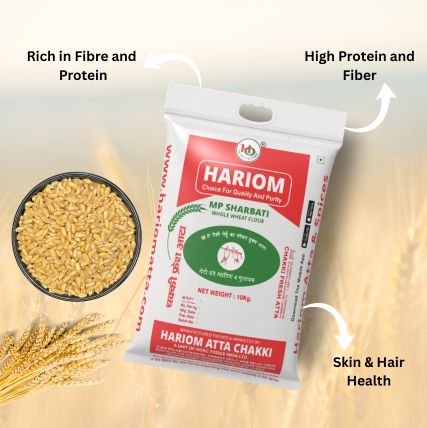
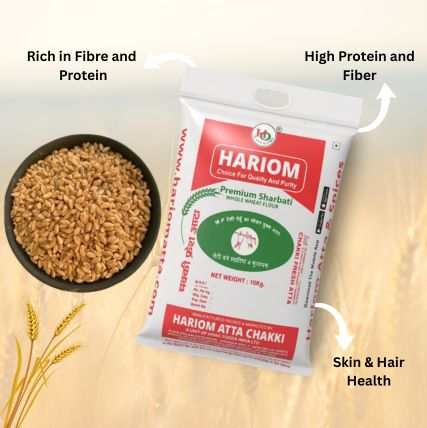
Geography built this wheat's reputation over generations but freshness is what lets you actually taste it. At Hariom Atta, every batch of wheat flour is stone-ground fresh on order, sourced directly from this same Madhya Pradesh wheat belt, so the natural sweetness and aroma that the soil and climate work so hard to produce actually survives the journey to your kitchen.