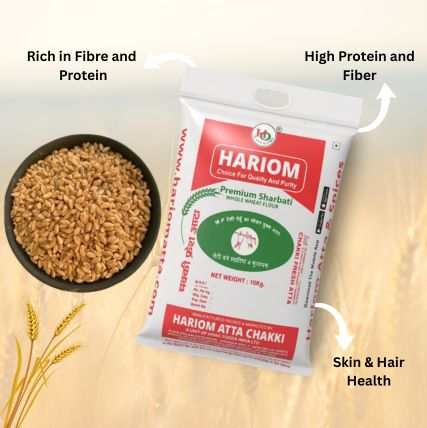
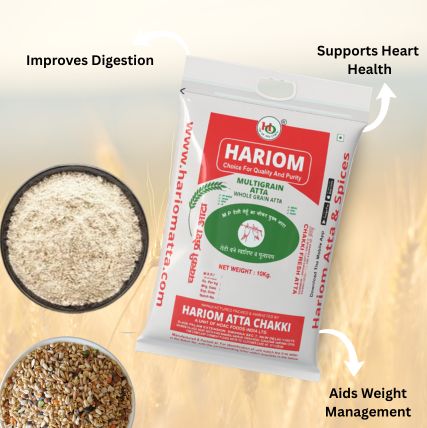
If you've ever wondered why your roti doesn't puff up like your grandmother's used to, the answer usually isn't your technique — it's your atta. Sharbati atta, grown in the Sehore and Vidisha belt of Madhya Pradesh, is widely regarded as the finest wheat flour in India, prized for its higher protein, natural sweetness, and soft, long-lasting rotis. This guide breaks down exactly what makes it different, how it compares to regular and commercial branded atta, and how to pick the right pack for your kitchen.
Sharbati atta is whole wheat flour milled from Sharbati wheat, a premium variety grown almost exclusively in the Sehore and Vidisha districts of Madhya Pradesh. The grain is larger than ordinary wheat, has a natural golden sheen, and is grown under rain-fed, low-moisture, potassium-rich soil conditions that don't require pesticides. This growing environment is what gives Sharbati wheat its higher protein content, natural sweetness, and superior gluten quality compared to standard wheat.
Sharbati Atta vs Regular Atta vs Branded Commercial Atta
Most shoppers are really choosing between three things: loose regular wheat atta from a local mill, Sharbati atta, and mass-market branded atta sold in supermarkets. Here's how they actually compare:
|
Factor |
Regular Wheat Atta |
Mass-Market Branded Atta |
Sharbati Atta (Hariom) |
|
Protein content |
Standard (~10-11%) |
Standard, often blended |
~2% higher, naturally |
|
Milling process |
Varies by mill |
Large-batch industrial roller milling |
Stone-ground (chakki), small-batch |
|
Freshness |
Depends on local mill |
Milled weeks/months before reaching shelf |
Milled fresh, close to order/delivery |
|
Additives |
Sometimes bleached/treated |
Often contains conditioners or blended flours |
None — 100% pure, chemical-free |
|
Pesticide exposure |
Varies |
Varies by sourcing |
None — rain-fed cultivation needs no pesticides |
|
Roti texture |
Average softness, dries faster |
Consistent but often flatter, less aromatic |
Soft, puffs up easily, stays fresh in the dabba longer |
|
Taste |
Neutral |
Neutral to bland |
Naturally sweet, aromatic |
The takeaway: regular atta gets the job done, mass-market branded atta optimizes for shelf life and consistency at scale, but Sharbati atta from Madhya Pradesh optimizes for what actually matters at the roti stage — protein, moisture retention, and taste.
Health Benefits of Sharbati Atta
A 100g serving of whole wheat Sharbati atta typically provides:
- Protein: ~12–14g — supports muscle repair, satiety, and steady energy
- Dietary fibre: ~10–12g — aids digestion, gut health, and blood sugar regulation
- Complex carbohydrates — slow-release energy instead of quick spikes
- Iron, magnesium, zinc — micronutrients that are largely stripped out of refined maida
- B vitamins — retained naturally because the wheat bran isn't removed during stone grinding
Because Sharbati wheat is rain-fed and grown in low-moisture, potash-rich soil, it doesn't need pesticides or insecticides to thrive — making it a naturally chemical-free flour choice, not just a "no additives" claim on a label.
Why Stone-Ground (Chakki) Milling Matters
Industrial roller mills process wheat at high speed and high heat, which can strip out nutrients and dry out the flour's natural oils. Traditional chakki (stone) grinding is slower and cooler, which:
- Preserves more of the bran and germ (and their nutrients)
- Keeps the flour's natural moisture and oils intact — this is why chakki atta dough feels different to knead
- Produces a finer, more even grain that absorbs water consistently, giving you softer, more elastic dough
This is one reason freshly milled Sharbati atta noticeably outperforms flour that's been sitting on a supermarket shelf for weeks.
Buy Freshly Milled Atta From Hariom Atta Range-
How to Get the Softest Rotis From Sharbati Atta
- Rest your dough. Knead well and let it rest 20–30 minutes so the gluten fully relaxes before rolling.
- Use lukewarm water to knead — it activates gluten more effectively for smoother, more elastic dough.
- Don't over-flour your rolling surface — a light dusting is enough; too much dry flour toughens the roti.
- Cook on medium-high heat on a properly heated tawa so the roti puffs up fully.
-
Finish with a dab of ghee immediately off the tawa to seal in softness and moisture.
Frequently Asked Questions
Is Sharbati atta better than normal atta? Yes. Sharbati atta has roughly 2% higher protein and better gluten quality than regular wheat atta, which means softer, more elastic rotis that stay fresh longer in a lunchbox.
Is Sharbati atta pesticide-free? Yes. Sharbati wheat is rain-fed and grown in low-moisture, potassium-rich soil, which naturally eliminates the need for pesticides or insecticides.
Which is healthier, Sharbati atta or maida? Sharbati atta is significantly healthier. Unlike maida (refined flour), it retains the wheat bran and germ, giving you fibre, B vitamins, iron, magnesium, and zinc that maida loses during refining.
Where can I buy fresh Sharbati atta online in India? You can order fresh MP Sharbati Atta and Premium Sharbati Atta directly from Hariom Atta & Spices at hariomatta.com, available in 1 kg, 5 kg, and 10 kg packs, stone-ground and delivered fresh.
Why does Sharbati wheat come from Madhya Pradesh specifically? Sharbati wheat is grown almost exclusively in the Sehore and Vidisha districts of MP, where the rain-fed, low-moisture, potassium-rich soil produces larger grains with higher protein and natural sweetness — conditions not easily replicated elsewhere.
How should I store Sharbati atta to keep it fresh? Keep it in an airtight container in a cool, dry place away from direct sunlight. Since fresh chakki atta has no preservatives, buying smaller batches more frequently (rather than one large bag left open for months) helps preserve its taste and nutrition.
Buy freshly milled atta from Hariom Atta & Spices