If you've ever compared the price tag on a bag of Sharbati atta against ordinary wheat flour and wondered whether you're paying for the grain or just the name, it's a fair question. Sharbati typically costs noticeably more than standard wheat and unlike a lot of "premium" food pricing, the gap here isn't mostly marketing. It comes down to a small, specific set of agricultural and supply-side realities that genuinely make this wheat harder and more expensive to produce.
Here's exactly where that extra cost comes from.
Why Is Sharbati Wheat Expensive?
Sharbati wheat is expensive primarily because it's grown in a very limited geographic region, mainly the Sehore and Vidisha districts of Madhya Pradesh under low-irrigation, rain-fed conditions that naturally cap how much can be produced each season.
Add to that its higher protein and gluten content (which makes it genuinely better for soft rotis), labor-intensive cultivation, and consistently strong demand that regularly outpaces supply, and you get a wheat variety that commands a real, justified premium over ordinary wheat.
1. It Only Grows Properly in One Specific Region
This is the single biggest reason Sharbati costs what it does. Unlike high-yield wheat varieties that are bred to perform well across a wide range of soil and climate conditions, authentic Sharbati wheat is closely tied to the black and alluvial soil of the Sehore-Vidisha belt in Madhya Pradesh, a region agricultural traders often refer to as India's "golden belt" for wheat.
Grow the same seed outside this belt, and you simply don't get the same grain. That geographic dependency means total Sharbati production is naturally capped by how much land in this specific region is under cultivation each season; there's no easy way to scale supply the way you can with wheat varieties bred for broader adaptability.
2. Lower Yields Than High-Yield Commercial Wheat
Most of the wheat that fills India's mandis comes from high-yield varieties (HYVs) specifically bred to maximise output per acre that's their entire purpose. Sharbati was never bred with yield as the priority; it was preserved and grown for grain quality, taste, and milling performance instead.
The result is that farmers growing Sharbati typically harvest less wheat per acre than they would with a standard HYV crop. Lower output per acre means a higher cost per kilogram has to be passed down the chain just to make the cultivation worthwhile for farmers; this is one of the most consistent patterns across nearly every premium wheat variety in India, not just Sharbati.
3. Rain-Fed, Low-Irrigation Farming Is Riskier and More Labour-Intensive
Much of Sharbati cultivation relies on rain-fed, low-irrigation farming rather than the heavy, controlled irrigation used for mass commercial wheat. This isn't accidental; it's part of what gives the grain its distinctive density and natural sweetness, but it also makes the crop more vulnerable to seasonal rainfall variation and generally more demanding to manage well.
Careful cultivation and harvesting practices that minimize grain damage, combined with the closer, more hands-on farming this variety requires, add real labor costs that simply aren't there with mechanized, high-irrigation wheat farming.
4. Higher Protein Means Better Performance and Better Performance Costs More
Sharbati wheat carries a protein content of roughly 12–14%, compared to around 10–11% in regular wheat. That difference might look small on paper, but it has an outsized effect on cooking performance: higher protein builds a stronger gluten network, which is exactly why Sharbati dough holds moisture better, rolls out more easily, and produces rotis with noticeably better elasticity and that satisfying full puff on the tawa.
This isn't a marketing claim; it's measurable, and it's the reason mills and traders are willing to pay more for Sharbati grain at the source, which naturally carries through to the retail price.
5. Processing Matters Too: Stone-Ground Atta Costs More to Produce
A meaningful part of Sharbati's price premium also comes from how it's typically milled. Quality Sharbati atta is usually stone-ground (chakki-milled) rather than processed through high-speed industrial roller mills. Stone grinding preserves the grain's natural oils, bran, and germ, exactly what gives the flour its aroma and nutritional density, but it's a slower, lower-throughput process than industrial roller milling.
Compare this to maida, which is roller-milled at scale and stripped of its bran and germ entirely. Less processing time per batch, combined with retaining parts of the grain that roller mills simply discard, adds real cost, but it's also the reason genuine Sharbati atta tastes and performs the way it does.
6. Demand Has Consistently Outpaced Supply
Sharbati's reputation has only grown stronger over the past decade, particularly across Madhya Pradesh, Rajasthan, and Uttar Pradesh, where it's become something close to the default "good atta" in many households. That popularity creates straightforward economic pressure: a genuinely limited, geography-bound supply meeting consistently rising household demand pushes prices upward, the same way it would for any in-demand, hard-to-scale agricultural product.
This demand pressure is also exactly why Sharbati is one of the most commonly mislabeled wheat varieties in Indian markets; sellers sometimes pass off regular high-yield wheat as "Sharbati" to capture some of that premium without actually sourcing the real grain. Genuine Sharbati wheat has fairly consistent identifying traits: uniform golden grains, a clean earthy aroma, and reliable sourcing information from the seller, usually naming Sehore or a nearby Madhya Pradesh district specifically.
Is the Extra Cost Actually Worth It?
For households that eat roti daily, which describes most of India, the honest answer is usually yes, and not for sentimental reasons. Better gluten quality means less wastage from torn or dry dough, rotis that stay soft and edible for hours longer without needing extra ghee or reheating tricks, and a noticeably better eating experience, meal after meal.
The price gap between Sharbati and ordinary wheat atta is also generally more modest than people expect, often a difference of a few rupees per kilogram rather than a dramatic markup, which makes the trade-off easier to justify once you factor in the freshness and performance difference.
Frequently Asked Questions About Sharbati Wheat Pricing
Why is Sharbati wheat more expensive than regular wheat? Sharbati wheat is more expensive primarily because it's grown in a limited geographic region (mainly Sehore and Vidisha in Madhya Pradesh) under rain-fed, low-irrigation conditions that naturally limit how much can be produced, combined with lower yields per acre, higher labor input, and consistently strong consumer demand.
Is Sharbati wheat worth the higher price? For most households eating roti daily, yes. The higher protein and gluten content means softer, more elastic dough; rotis that stay fresh longer, and less wastage benefits that generally offset the modest price premium over regular wheat atta.
How much does Sharbati wheat cost compared to regular wheat? Pricing varies by region, season, and seller, but Sharbati typically commands a premium of roughly ₹10–20 per kilogram over standard wheat atta, reflecting its limited supply and superior milling and cooking quality.
How can I tell if Sharbati atta is genuine? Authentic MP Sharbati wheat typically has uniform, golden grains of consistent size, a clean earthy aroma, and a seller who can clearly identify the sourcing region (usually Sehore or a nearby Madhya Pradesh district). Be cautious of unusually low prices, since genuine Sharbati is limited in supply and priced accordingly.
Does stone-ground Sharbati atta cost more than machine-milled atta? Yes, generally. Stone grinding (chakki milling) is a slower process that preserves the grain's natural oils, bran, and germ but produces less flour per hour than high-speed roller mills, a trade-off that adds modest cost but results in noticeably better flavor and nutrition.
Genuine Sharbati, Sourced and Milled the Right Way
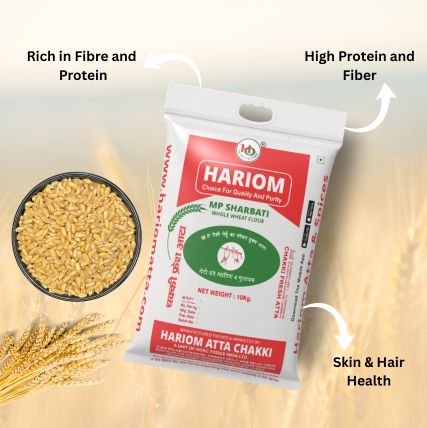
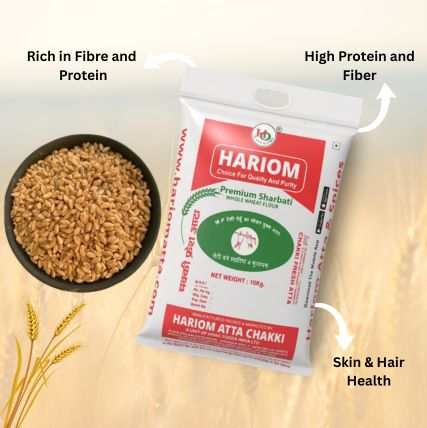
The price of real Sharbati wheat reflects real agricultural constraints, not branding. At Hariom Atta, every batch of M.P. Sharbati wheat flour is sourced directly from the Sehore-Vidisha belt and stone-ground fresh on order, so the premium you pay goes toward the grain and the process, not warehousing or middlemen.
Shop Hariom's M.P. Sharbati Wheat Flour →
To understand exactly what this wheat does differently in your kitchen, see our companion guide: what is Sharbati atta, and why every Indian kitchen should have it.